
Question 1
What is it?
Orenda gives industrial teams one modular edge platform for machine data, local applications, lifecycle management, AI-powered decision support, and controlled remote service.
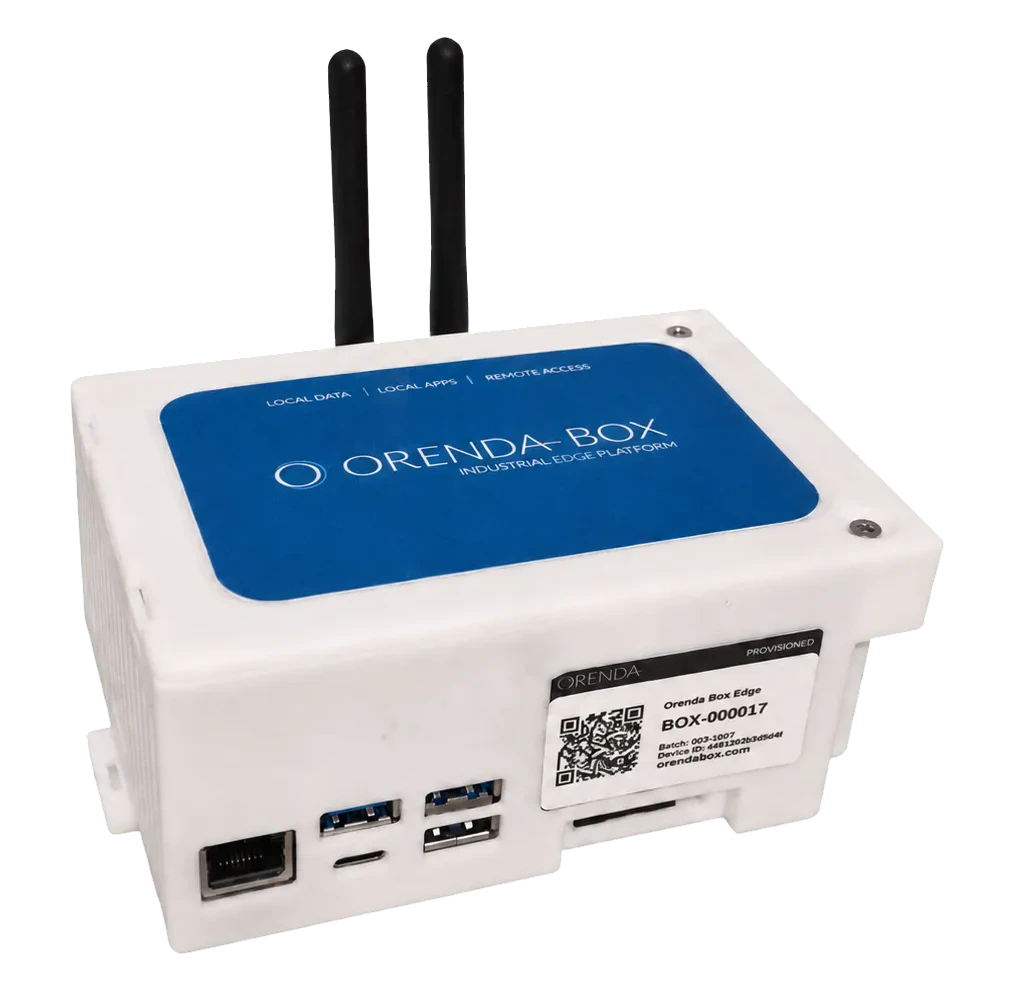
Orenda Box installs beside a PLC. It records selected signals, such as machine state, output, stops, alarms, temperatures, and counters, and keeps that operating history on site.
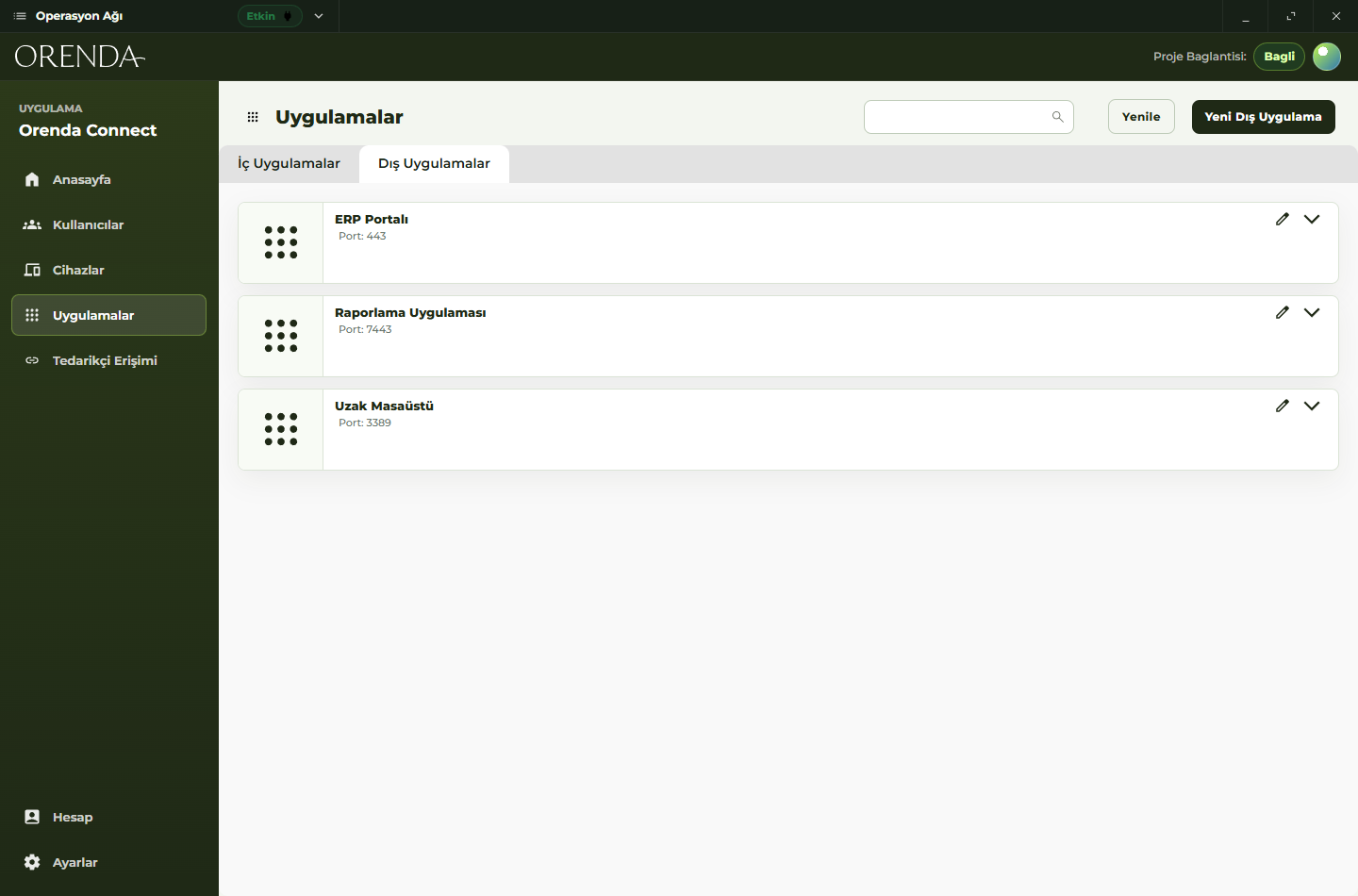
Approved MES, SCADA, and diagnostic applications run on the Box. In Orenda Connect, a technician opens only the machine resource assigned to them instead of opening the customer’s whole network.
Orenda AI analyzes recent production and maintenance history as part of the operational workflow. It finds recurring problems, creates maintenance reports and smart alarms, and recommends the next check.
- Record the few PLC signals that explain the service problem
- Run the applications the machine and service team already need
- Turn machine history into reports, alarms, and recommended checks
- Give each technician access only to an approved machine resource
Question 2
Who’s the customer, and what do we know that others don’t?
We can serve the people who build, operate, and service industrial equipment. Our first commercial focus is on teams that remain responsible for equipment after deployment.
The first users are owners, after-sales leaders, plant operators, automation teams, and service partners. A machine builder may want a repeatable installed-base service layer; a factory may want local applications and operational visibility; an automation or service partner may want to manage equipment across customers. When a machine stops, teams often start with calls and screenshots before they have the machine history needed to diagnose it remotely.
Aquant’s industrial-machinery benchmark puts the average service event at $1,303. When the first visit fails, the case takes three visits and about 13 extra days. This is a benchmark for comparable service teams, not a measured Orenda customer result.
Remote access alone does not solve the problem. The builder needs machine context, approved local tools, controlled access, and useful maintenance guidance in one repeatable machine-model setup.
An İzmir tortilla-machine builder tried other remote-service products before testing Orenda. According to the founder, none of the competing products gave the builder the complete hardware and software system it needed; Orenda combined the hardware, remote service, machine integration, and AI. The builder signed an LOI. The deal is not closed; the next step is a paid standardization project.
The buyer needs more than remote access. It needs a service system that can travel with the machine.
Customer insight
Question 3
What’s the white space?
The white space is the engineering between a remote-access tool and a complete service operation. Machine builders can buy the parts, but they still have to make the parts work together.
With separate products, the builder must connect remote access, PLC data, local applications, AI, user access, updates, and recovery. Orenda provides these functions in one platform with ready integrations and one reusable setup for each machine model.
After the first setup, the next compatible machine needs three actions: mount Orenda Box on the panel rail, connect Modbus, and scan the QR code to add the device to the Orenda Connect project.
Service then starts before the customer reports a fault. AI watches the machine history, sends a warning to the configured builder, maintainer, or operator, and suggests an action. The AI never changes the machine. An authorized person can inspect the data on mobile or desktop and change approved PLC values through the configured data layer.
The work map uses comparable industry cases until Orenda has measured the same jobs with customers. Labor calculations use €39.80 per hour unless a source reports its own rate. Product fees, parts, and factory losses are kept separate.
White-space work-map
| Job | Hours today | AI / Labor+AI / Never | Cost before → after | Sequence |
|---|---|---|---|---|
| Build and validate the complete service stack for one machine model | At least 80 h, benchmark | Never | At least €3,184 → about €318 of internal labor | Setup, once per model |
| Install the approved setup on another compatible machine | 2 h, benchmark | Never | €80 → about €13 of internal labor | Deploy, once per machine |
| Watch machine history, detect a developing fault, route the warning, and suggest an action | Not done manually; a missed critical warning caused 8 h of downtime in a comparable trial | AI | $21,500 estimated loss → $0 of that loss when the event was prevented | Continuous, before the customer reports a problem |
| Inspect machine data and change approved PLC values remotely | 4 h of access and troubleshooting overhead, benchmark | Labor+AI | €488 → €122 of technician labor | After a warning; a customer report is the fallback |
| Guide the local maintainer or dispatch a technician under the customer’s service policy | Labor+AI | €1,445 → €425 expected diagnostic callout cost, planning proxy | After remote diagnosis, when physical work may be needed | |
| Repair a physical fault and confirm that the machine can restart | Never | Onsite exception | ||
| Document the result and update the service history | Labor+AI | After the case | ||
| Review the machine-health report and plan maintenance | Labor+AI | Month-end or customer schedule |
The gap is not another remote-access device. It is the engineering required to turn separate tools into one service system that can be reused on every compatible machine.
The white space
Question 4
Why now, and how big?
Machine builders are being asked for remote service and predictive maintenance, but many still lack the machine history that makes either one useful.
In PMMI’s 2024 U.S. packaging survey, 83.1% of end users said predictive-maintenance capability mattered, while 75% of OEM respondents did not offer it. Customers want the capability, but most OEMs still do not sell it.
The same survey found that 43.2% of end users work through several remote-service interfaces and another 15.3% use a different system for every machine. A machine builder that can ship one consistent service layer has a practical advantage.
The customer base is also export-heavy. UCIMA counted 619 Italian packaging-machinery companies in 2024, and 79.4% of their revenue came from exports. These builders must support machines far from their own service teams.
Management scenario: if 20 builders each make 5 to 10 suitable machines a month and attach Orenda to all of them, they add 1,200 to 2,400 Boxes a year. This is target math, not contracted volume or a forecast.
Question 5
Show, don’t tell.
The 101-second demo starts with a stopped tortilla line and ends with a recommended first check and access to one approved machine resource.
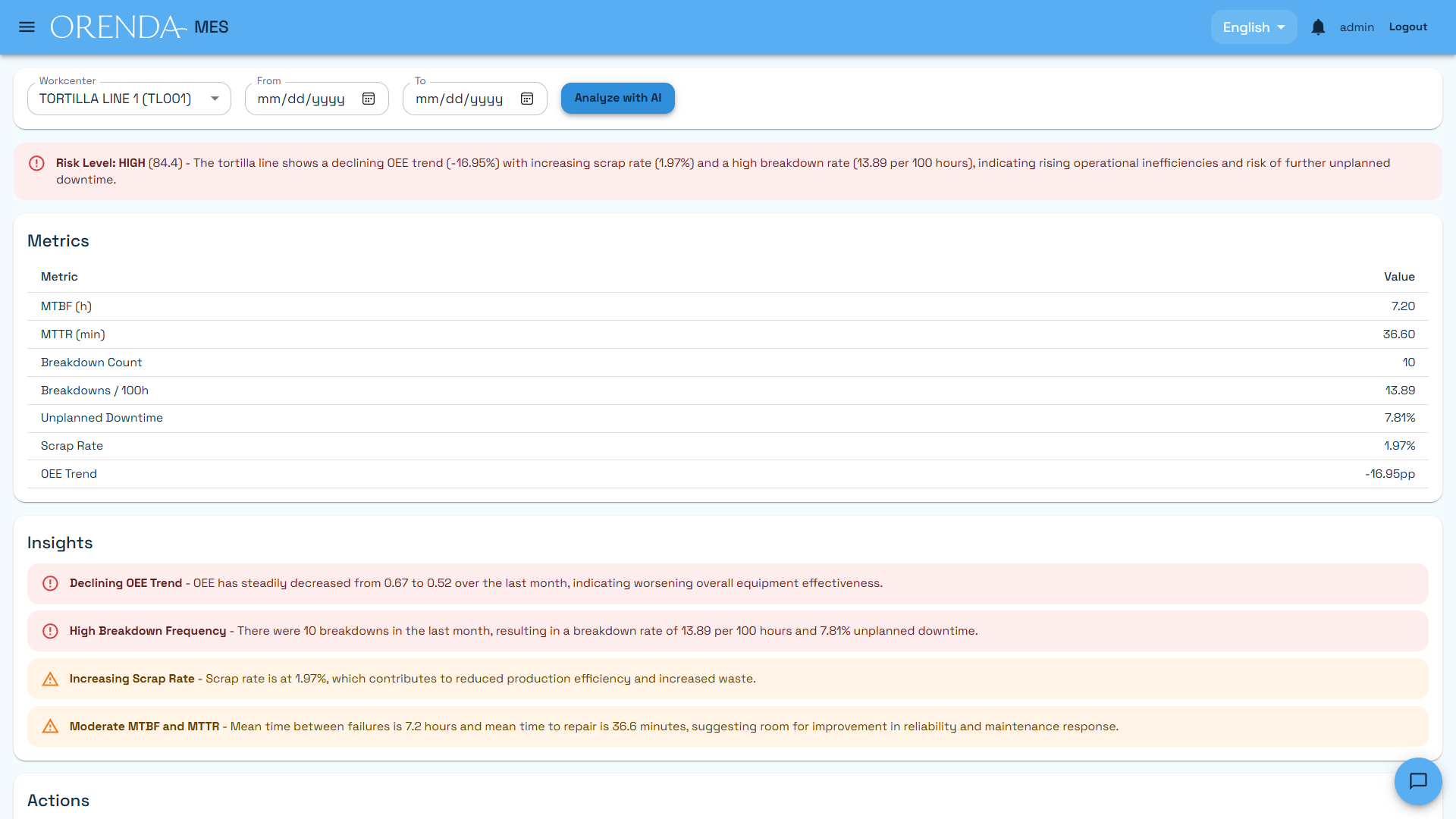
The demo uses seeded tortilla-line data in live product interfaces. Orenda MES shows 10 breakdowns, an 84.4 risk score, a 16.95-point OEE decrease, and 6.1 hours of downtime in Oven Zone 2.
A live model call analyzes that history. It identifies recurring problems and risk indicators, creates a maintenance report and smart alarms, and recommends the first check. Orenda Connect then opens only the assigned machine resource.
The interfaces and model call are live. The machine values are demo data, not customer results.
- See the machine state and production history
- Find the area with the highest recorded risk
- Create the maintenance report and recommended first check
- Open the approved resource through Orenda Connect
Question 6
Where’s the demand?
An automation partner has started an Orenda project across 40 factories, with Boxes deploying gradually across that network.
The automation partner is introducing Orenda across 40 factories, and Boxes are being deployed progressively as each site is ready.
The rollout is already moving beyond a single pilot: 15 Boxes are paid and the first deployments are active, while the remaining factories create a natural expansion path for the same platform.
The machine-builder signal is the İzmir LOI: the builder tested competitors before Orenda and moved forward after testing Orenda’s hardware, remote service, machine integration, and AI workflow, although the commercial order is not closed yet.
Together, the rollout and the LOI show two forms of demand - partner-led deployment across multiple sites and machine-builder pull after a real competitor comparison - while the next proof is repeat installation and paid standardization.
An İzmir builder tried competing products first, then signed an LOI because Orenda was the only tested option that combined easy hardware integration, remote service, and AI.
Competitor trial
Question 7
What are the economics?
A standard Box is €1,000 and a 4G Box is €1,200. Connect is priced from €14.50 to €99.50 a month.
A standard Box sells for €1,000. Manufacturing and packaging cost €200, leaving €800 before fulfillment, warranty, support, cloud, sales, and channel costs.
A 4G Box sells for €1,200. Manufacturing and packaging cost about €285, leaving about €915 before the same costs.
Published Connect prices are €14.50, €39.50, and €99.50 a month. They are current promotional prices. Subscription revenue is still zero, and the paid-per-Box policy used in the target model must be written into the commercial offer.
Machine-model engineering is quoted at €450 per person-day. The total depends on the accepted scope. The three planned revenue sources are integration, Box sales, and paid Connect plans.
The ideal model reaches about €10 million in EBITDA in 2031 with 10,000 annual Box sales and about 29,000 paid Connect plans at year-end. The full-year result uses about 24,500 average paid plans. Question 8 shows the path and the assumptions.
Current prices and known costs
| Product | Price | Manufacturing and packaging | Before other costs |
|---|---|---|---|
| Standard Box | €1,000 | €200 | €800 |
| 4G Box | €1,200 | About €285 | About €915 |
Question 7b
How does revenue compound?
Under our proposed pricing, each machine model brings one integration fee, each compatible machine brings a Box sale, and each active Box carries a paid Connect plan.
The model starts when a builder pays to standardize one machine model. Once the configuration is accepted, the builder can reuse it and make later compatible installations plug-and-play instead of starting another engineering project.
A builder that makes 5 to 10 suitable machines a month could add 60 to 120 Box sales a year at full attach. This is management scenario math, not current volume.
At the published Growth price of €39.50 a month, 100 paid Growth plans would equal €47,400 in ARR and 1,000 would equal €474,000, before any further discount or attrition. More paid users, applications, and vendor access can raise account value without another hardware sale.
- 01 · Standardize the machine model once
- 02 · Reuse the plug-and-play setup on each compatible machine
- 03 · Keep the active fleet on paid Connect plans and add software as use grows
Question 8
What’s the wedge, and how does the model resolve?
Start with one paid machine-model integration. The test is whether a reseller can repeat it on the next suitable machine without founder field work.
The first paid engagement solves one service problem using selected PLC signals. It delivers one local view, one approved remote-service resource, one AI maintenance report, one reusable machine-model setup, and a written acceptance test. The Box, engineering work, and Connect plan are priced separately.
The proposed target is a useful service workflow within five business days after a site-ready installation and acceptance within 14 days. These are targets, not measured results.
The model resolves when the builder pays, accepts the setup, orders another Box, and a trained reseller completes the repeat installation. That turns one engineering project into a repeat product and service channel.
Ideal-case operating path
| Input | 2027 exit | 2028 | 2029 | 2030 | 2031 |
|---|---|---|---|---|---|
| New Boxes | 2,400 annualized | 4,000 | 6,000 | 8,000 | 10,000 |
| Machine-model standardizations | 40 annualized | 50 | 75 | 95 | 125 |
| Team | 12 | 20 | 35 | 52 | 75 |
Resolution and growth plan
- 01End of 2027
20 integrated builders, 10 resellers, 2,400 paid plans at the exit run rate, 12 people, €3.9 million annualized revenue, and a €2 million annualized EBITDA exit run rate.
- 02In 2 years · 2028
35 builders, 18 resellers, 4,000 Box sales, about 4,400 average paid plans and 6,300 at year-end, 20 people, €6.5 million revenue, and €3.1 million EBITDA.
- 03End of 2030
75 builders, 38 resellers, 8,000 Box sales, about 16,000 average paid plans and 19,800 at year-end, 52 people, €16.4 million revenue, and €7.5 million EBITDA.
- 04In 5 years · 2031
100 builders, 50 resellers, 10,000 Box sales, about 24,500 average paid plans and 29,000 at year-end, 75 people, €22.7 million revenue, and €10 million EBITDA.
The test is simple: the builder orders a second Box, and a reseller installs it without a founder on site.
Resolution test
Question 9
Is this the business you were meant to build?
Ömer saw the service problem in manufacturing projects. Suna knew how to build the distributed system needed to solve it.
Ömer saw the problem while leading manufacturing-software work at Dera Technology. After machines left the factory, service teams diagnosed faults from calls and screenshots because they did not have one reliable machine history. That experience led him to build Orenda.
Ömer has worked in cryptography, semiconductor architecture, embedded systems, industrial software, customer projects, field deployment, and commercial delivery.
Suna has worked on enterprise and distributed systems at Softtech, SabancıDX, and Microsoft. She leads the software architecture and quality behind Orenda’s device, access, application, and update platform.
Ömer and Suna have worked together since they co-founded the Creatiny student club. In eight months of full-time execution, they took Orenda to traction and profitability and completed its first international deployment in Bulgaria.
Team by role
| Role | Owner | What they own now |
|---|---|---|
| CEO, sales, and demand | Ömer Akgül | Machine-builder and reseller sales, field delivery, and commercial execution |
| Product, delivery, and quality | Suna Ayhan with Ömer | Software architecture, integrations, deployment, and product quality |

Question 10
Why build this with Gateway X?
Gateway X brings customer-acquisition experience, an expansive network, and practical operating support. We want to use those strengths to open the right doors in industry and build a supply chain that can handle growth.
Orenda will own sales, partner development, sourcing, and delivery. What we want from Gateway X is access to the right customers, channel partners, suppliers, and operators.
Specific asks for the Gateway X team
Jesse · industry relationships
- Introductions to owners and after-sales leaders at machine builders, factory groups, system integrators, and industrial distributors.
- Help reaching the few people who can roll Orenda across many machines or sites, instead of building a long list of weak leads.
- A network that stays useful: customers introduce partners, partners open markets, and each successful project creates the next conversation.
Adam · technology network
- Introductions to hardware and technology partners who understand industrial edge systems, secure remote service, and long-life components.
- Access to experts who can challenge important architecture and component choices before they become expensive constraints.
- Connections to technical partners who can help us support more machine types without turning each customer into a custom project.
Nak · supply-chain resilience
- Introductions to reliable component suppliers, contract manufacturers, logistics providers, and quality specialists.
- Practical guidance as we qualify primary and backup sources for every critical part, approve substitute components, and protect lead times.
- A supply plan that protects quality and cash when demand changes or a supplier, component, or route fails.
Orenda brings the product, factory experience, and early reseller relationships. Gateway X can help us surround them with the customers, partners, and supply options needed for durable growth.
The goal is not a list of introductions. It is a network that repeatedly creates customers, channel partners, and reliable supply options.